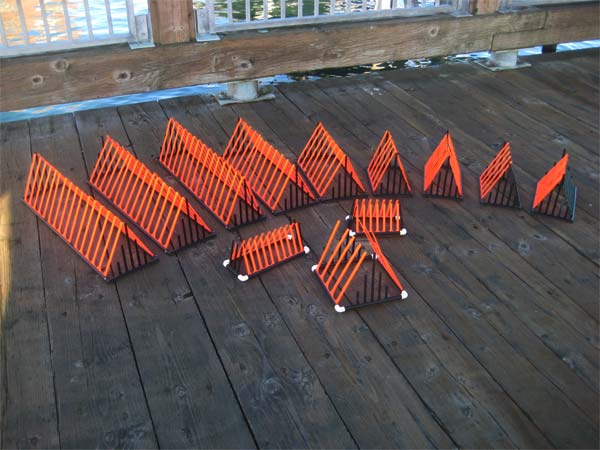
Crab fishermen originally used Neptune equipped crab pots to catch cod for crab bait. It proved so effective in catching Pacific cod that a directed fishery developed
his new gear type proved to be very selective in the pursuit of cod without catching crab or halibut. The cod pot fishery also proved to be selective in catching mature fish through the use of web sizes that allowed smaller fish to escape. One of the other benefits that also became evident was the low bycatch mortality of unwanted species, or smaller animals, that happened to be hauled to the surface in the pot. Most are returned to the sea unharmed and in good condition. The benefits that became evident in the Alaska cod pot fishery might prove beneficial in various Atlantic fisheries as well. Hopefully the following information will help inform you about the options and possibilities for catching various fish species with pots.
The cod pot fishery in Alaska developed around modifying the existing king and tanner crab pots already in use. These pots were usually around 7’ X 7’ X 3’ and would weigh 400-600 lb. These crab pots have two opposing tunnel ramps leading to horizontal mounted rectangular steel rod “tunnel eyes”. The tunnel eyes were mounted horizontal because of the shape of the crab being caught. To modify these crab pots into cod pots, fishermen would re-orient the horizontal tunnel eye so that it was perpendicular to the pot’s bottom and then attach Neptune Cod Triggers. This horizontal orientation of the tunnel also worked for cod and became the standard tunnel orientation used in Alaska.
Fishermen soon developed dedicated cod pots that were designed specifically for cod. These cod pots share common design components that apply to fish pots in other areas as well. Alaska fishermen also developed cod pot fishing methods that should be of interest to future Atlantic fish pot fishermen.
POT DESIGN CONSIDERATIONS AND FISHING METHODS
LARGE INTERNAL VOLUME POTS CREATE BETTER FISHING POTS - Evidence gathered worldwide from fishermen and researchers indicate that pots with large internal volumes caught more fish than smaller pots. The original Alaska crab/cod combination pot has a lot of internal volume taken up with the tunnel ramp for the crab. New dedicated cod pots have shallower leads creating more internal space. This allows more fish in the pot before saturation effects keep additional fish from entering. Fish pots in Alaska use a welded steel rod framework that uses stretched nylon netting as a covering. It is also possible to create large pots with the common wire mesh used in lobster traps.
MULTIPLE ENTRANCES WORK BEST Most dedicated cod pots in Alaska now use cod triggers on 3 sides of the pot. Multiple entrances insure a better chance of fish entering the pot. Fish usually are attracted by the bait smell down current from the pot. With the direction of the current changing with the tide, it is best to have an entrance easily available to fish no matter which direction the current is coming from. Norwegian research confirms the benefits of multiple entrances in most fish pot designs as well.
USE PROPER WEB SIZE, OR ESCAPE VENTS, TO ALLOW ESCAPE OF SMALL FISH It’s important to design fish pots that allow for the escape of small fish. These fish represent the future of the fishery. If stretched nylon web is used to cover the pot’s steel frame, select a web size that will allow small fish to escape. If plastic coated wire is used to construct the pot, circular escape rings, or vents, can be placed in the wall of the pot to allow escape routes for small fish.
THE USE OF BAIT BAGS IS HIGHLY RECOMMENDED In pot fisheries where bait is used, the use of bait bags will increase your catch rates. As the first fish in the pot start to bite and rip at the bag, small bits of bait float off in the current attracting more fish to the pot. As fish rip at the bag, a “feeding frenzy” develops that entices more fish to
enter the pot in search of a meal. Chopped herring is the preferred bait in the Alaska cod pot fishery. Bait bags should be hung so they can easily be seen between the fingers of the trigger entrance devices.
FISH POTS FISH FAST Alaska cod pot fishermen noticed that with the use of bait bags, their cod pots fish fast. Once the bait is gone, few fish attempt to enter the pot and the fish inside the pot start to seek escape routes. It makes no sense to let the pot soak any longer. Alaska cod pot fishermen will often pull their pots 2-3 times per day. In the Alaska State Waters cod pot fishery, boats are only allowed 60 pots in recognition of this fact. The fast fishing capability of most baited fish pots allows smaller vessels to participate in the fishery with less pots if they pull them frequently. Nesting and collapsible pot designs are also available for smaller boats.
VERTICAL VERSUS HORIZONTAL TRIGGER PLACEMENT Some species such as scup have a vertical profile and would be hindered entering a horizontally mounted trigger. Neptune triggers can easily be mounted vertically to accommodate these species. While the Alaska cod pot fishery has stuck with horizontal mounted triggers, there is no reason why vertical mounting wouldn’t work well for round shaped fish like cod or haddock. Some vertical trigger placement ideas are shown on the drawings below. The view is looking down on the top of the pot. The conceptual trap design drawings show inwardly leading panels that lead to the Neptune triggers shown in red.
APPLICATIONS FOR ATLANTIC SPECIES - The main species of interest in the Atlantic include Atlantic cod, black sea bass, scup, haddock and pollock. Experimental fishing activities in the UK and Ireland with Neptune equipped pots showed catches of a variety of species including cod, pollock, ling, conger eel, and others. Applications probably exist for a number of Caribbean species such as grouper, bass and various reef fish species as well.
NEPTUNE TRIGGER DESIGNS FOR ATLANTIC SPECIES
Neptune Triggers are made with plastic components that can be made into a number of shapes and sizes. They are easily self-assembled with a minimal amount of equipment and manpower. Neptune finger units are slid into pieces of silt pipe that are connected with plastic elbows into square or rectangular shapes using multi-purpose solvent cement. The finger units can be used whole or can be cut to create various trigger sizes. Regular and mini finger units are available in UV resistant black or in fire orange. End pieces are only available in black.

Regular fingers are 10” long, ½” wide, & 1/8” thick. Fingers are spaced 1 ¾ “ apart. Backbone is 11” long.
Long mini fingers are 9” long, .375” wide, & 1/8” thick. Fingers are spaced .875” apart. Backbone is 6” long.
Short mini fingers have the same dimensions as the long mini fingers except the fingers are 6” long. The end pieces have the same thickness and spacing as the mini finger units with the middle finger being 9” long. The slit pipe comes in lengths of 36” and 33 ½”.

Prices for each trigger are for the components only and do not include freight or assembly fees. If you would like to order, or have any questions, contact us by email or phone us during business hours (8am 5 pm Pacific time zone). You can also have your trap builder or marine supply dealer contact us.
|