![]() |
|||||||||||||
![]() ![]() ![]() ![]() ![]() ![]() |
![]() ![]() ![]()
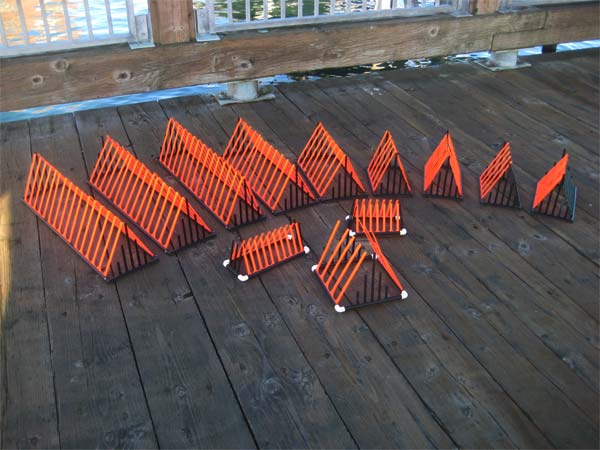
Neptune triggers are easy to assemble once you become familiar with the process. Since you will be using solvent cement, make sure you have good ventilation. A multi-purpose cement is required since you are joining ABS slit pipe and CPVC elbows. Wearing disposable plastic gloves is a good way to keep your hands clean from the cement. Make sure you have all pieces ready when you start to assemble. It is best to make up your end pieces first. Slide all end pieces into the pre-cut pieces of slip pipe. Using the dauber in the cement can, apply cement all around both ends of the slit pipe. Put your elbows on and place the end piece on a flat surface with the fingers pointing up. Quickly move the fingers to your desired position and insure both elbows are level and pointing in the same direction. Your end pieces should be allowed to set up at least 30 minutes to insure a good bond. A slight inward leaning angle is usually desired.
To attach the sidepieces holding fingers to the completed end pieces, there are a couple of ways to do this. If you are only making a couple of triggers, you can apply cement on the ends of the sidepieces and attach one end piece at a time. If you are making a number of triggers, we suggest you make a sidepiece holder that will hold the two sidepieces while you cement them and add the end pieces. We make our holder out of 2 pieces of slit pipe, although wood dowels would also work. We attach the 2 pieces of pipe to our workbench so they are parallel to each other and perpendicular to the workbench. The two pieces of slit pipe should be spaced so they fit into the gaps between the fingers. The sidepieces are held s o that the fingers point down. Once the sidepieces are placed on the holder, cement the ends of the slit pipe and attach the assembled end piece section. Then quickly do the other end the same way. Adjust the angle of the sidepieces to establish the gap between the finger tips. The cement sets up fast so be prepared to create your angle and gap as soon as the end pieces are attached to the sides. Set aside to cure. We stand the triggers on end and allow them to cure overnight. For extra strength and durability, stainless steel screws can be added to the elbows once the triggers have been assembled with solvent cement. We use ½” SS hex headed screws for this purpose. Drill a 1/8” pilot hole near both outer edges of each elbow so that it goes through the elbow and one side of the slit pipe. We use a Dremel tool and a brad point bit to quickly make the pilot holes. A regular drill will also work to make the pilot holes. Use a regular drill and hex headed bit to insert the SS screws. The finger units have ribs on one side for additional stiffness near the backbone. For fish triggers, we put the smooth side on the inside and the ribs on the outside. For crab and lobster triggers, we put the ribs on the inside to allow more “push points” for the tips of their legs and claws. Sometimes the spacing stub needs to be cut off to insure a full fit in the elbow. |
||||||||||||
|
|
|||||||||||||
|
|
|||||||||||||